Is 60 WPM Good? Where That Speed Ranks
By Mark Fulton ·
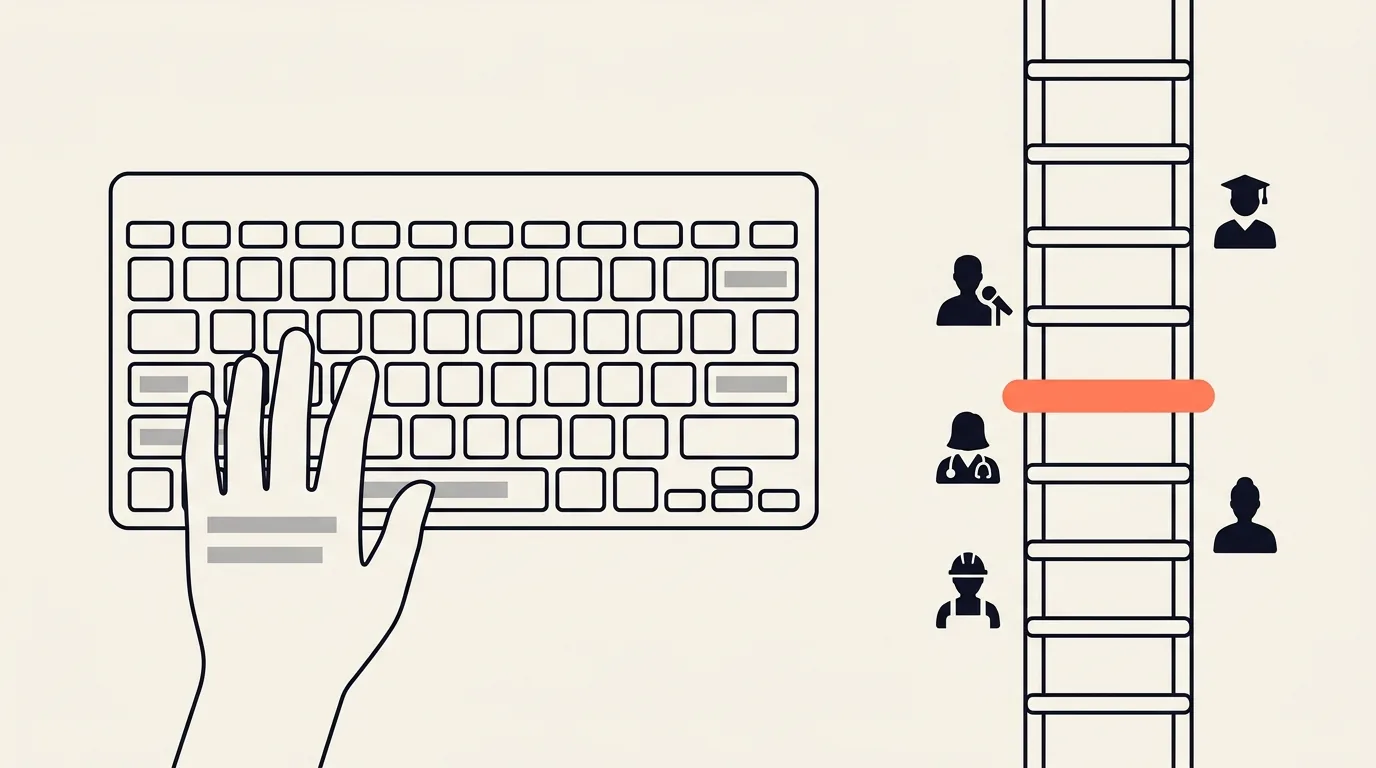
Yes, 60 WPM is good. It is above the average of the largest public measurement of typing ever collected, it clears the published minimum for every common office and clerical typing requirement in the United States, and it is the bottom edge of the band that professional typists occupied back when typing was the entire job. What 60 is not is remarkable. It will get you hired for work that involves typing. It will not get you hired for work that is typing, because those roles start where 60 leaves off. The useful question is not whether 60 is good. It is which specific bars you have already cleared and which ones are still ahead of you.
Here is the honest map of both, plus the reason your 60 might not actually be a 60.
How does 60 WPM compare with the average typist?
Above it, on the only measurement large enough to be worth quoting.
Researchers at Aalto University and Cambridge collected 136 million keystrokes from 168,000 volunteers across more than 200 countries, and the University of Cambridge write up of that study reports that the average participant typed 52 words per minute, with the fastest reaching about 120. The full paper, Observations on Typing from 136 Million Keystrokes, was presented at CHI 2018.
So 60 puts you roughly eight words per minute clear of the average person who sat down and took that test. That is a real gap, not a rounding error, and it is a harder group to beat than the general public. People who volunteer for a typing study are already people who type.
The same Cambridge write up carries a second number that reframes 60 nicely. Professional typists in the 1970s and 1980s, back when a typing pool was a department and the machine was the whole job, typically worked at 60 to 90 words per minute. At 60 you have arrived at the floor of what used to be a paid specialty. That is a fair way to think about the tier: you are competent by professional standards, at the entry end of them.
One more finding from that dataset is worth holding onto, because it contradicts what most people assume. The faster typists in the study made fewer errors, not more. Speed and accuracy were not traded against each other. They moved together, because both come out of the same habit of never looking at your hands. Anyone treating 60 as the point where they should start being careless in exchange for speed has the relationship backwards.
If you want the whole distribution rather than just your slice of it, what counts as a good typing speed lays out the full range.
Which job requirements does 60 WPM clear?
Almost all of the published ones. Here is the scorecard, split into bars you have already cleared and bars still ahead.
| Role category | Status at 60 WPM | What the requirement actually is |
|---|---|---|
| General office, admin support, receptionist | Cleared | Most postings name no number at all. Where one appears it is usually 40 to 50. |
| California state clerical, Office Assistant and Office Technician (Typing) | Cleared on speed | The published minimum is 40 WPM. The binding conditions are the format, not the number. |
| Public safety dispatch | Cleared on speed | Agencies commonly publish 40 WPM. The real gate is typing while processing live audio. |
| Data entry clerk | Cleared | 40 to 50 is the common stated floor. Numeric work is often scored in keystrokes per hour instead. |
| Customer service and live chat support | Cleared | Rarely a published number. 60 is comfortable across two or three concurrent chats. |
| Office assistant roles that publish a number | Cleared, exactly | 60 WPM shows up verbatim as a stated minimum on some administrative postings. You are at the line, not above it. |
| Executive assistant, word processing | Borderline | Document heavy work with formatting and dictation. 60 works. 75 stops it feeling like effort. |
| General transcription | Borderline | Paid per audio hour, so your speed is your hourly rate. 60 is workable and thin. |
| Medical and legal transcription | Short | Specialist terminology on top of speed. Postings in this category ask for materially more than 60. |
| Court reporting | Not applicable | Different machine entirely. See below. |
The pattern to read off that table: at 40 WPM you are asking whether you qualify. At 60 you mostly do, and the question changes to whether you are competitive. Where the posting names 40 or 50, you are past it with margin. Where the posting names 60, you match it precisely, which is a weaker position than it feels like, because "meets the minimum" is where a screen starts rather than where it ends.
Two honest footnotes on that table, because the number alone will mislead you.
California state clerical work is not gated on speed for you, it is gated on format. The state's typing certification requirements set 40 WPM as the minimum for classifications such as Office Assistant (Typing), but the test must be five minutes long, it must be proctored virtually or in person, and the certificate is honored for four years. The state will not accept a certification from a test that was unproctored or shorter than five minutes. Your 60 clears the speed bar with room to spare and still will not qualify unless somebody watched you type it. That applies to every unproctored online certificate, ours included. If you are applying for California state clerical work, book the proctored test through the agency.
Dispatch is the same story with an extra layer. The California Highway Patrol's Public Safety Dispatcher minimum requirements call for not less than 40 words per minute and an official typing certificate before hire, and note that you can be tested on site anyway. Your 60 clears that easily. What it does not tell anyone is whether you can keep typing accurately while a caller is talking over you, which is what the actual screening test measures.
Is 60 WPM with 90 percent accuracy actually 60?
Often not. This is the part that catches people who have been reading their gross number off a one minute test.
Certified and employer administered tests score net WPM, which subtracts a full word per minute for every error you leave in the text:
Net WPM = Gross WPM − (uncorrected errors ÷ minutes)
Accuracy is a separate measurement: correct keystrokes divided by total keystrokes pressed. Crucially, mistakes you backspace and fix still count against accuracy, because you did press the wrong key. How WPM is calculated works through the full chain.
Now put 60 WPM and 90 percent accuracy together on a three minute test and watch what happens. At 60 gross you produce about 900 characters over those three minutes. At 90 percent accuracy, roughly 90 of those keystrokes were wrong when you pressed them. Where those 90 errors end up decides your real score:
- You caught and fixed all of them. Net WPM stays near 60. Your accuracy is mediocre but your output is genuine. The cost was time, and it is already priced into the gross number.
- You left 15 of them in. Penalty is 15 ÷ 3 = 5. Net WPM is 55. Still a good score, and no longer the score you have been telling people.
- You left all 90 in. Penalty is 90 ÷ 3 = 30. Net WPM is 30. On a certified test that is a fail on a run that felt fast.
Ninety percent accuracy sounds respectable and is not. It means one keystroke in ten was wrong. The practical target for anyone reporting a number is 97 percent or better, at which point the error penalty stops being able to move your score much at all.
Test duration is the other thing that erodes a 60. Sprint pace does not survive contact with minute four. Fatigue, drifting attention, and one bad passage all show up in a longer run, and the published standards use five minutes precisely because a one minute score flatters almost everybody. Why your WPM differs on every typing test covers the other variables, including text difficulty and keyboard changes.
If your 60 came from a sixty second run, treat it as an upper bound rather than a measurement.
When is 60 not enough?
Three situations, and they are worth naming precisely rather than vaguely.
When typing is the product, not the tool. Transcription, captioning, and specialist document production pay by throughput. At 60 WPM against a working audio hour, you are simply earning less per hour than someone at 85, doing identical work at identical quality. Nothing about 60 is disqualifying there. It is just directly, arithmetically expensive.
When the score has to be proctored. Covered above, and it bears repeating because it is the single most common reason a legitimate score gets rejected. Speed is not the failure point. Format is.
When the job runs on a different machine altogether. Court reporting is the clearest example, and the numbers are so far outside the WPM conversation that comparing them is a category error. The National Court Reporters Association's Registered Professional Reporter certification requires passing three five minute dictation legs at 180, 200, and 225 words per minute, each at 95 percent accuracy. Those speeds are achieved on a stenotype machine, where chords produce whole words in a single stroke, not on a QWERTY keyboard. A 60 WPM typing score says nothing at all about whether you could do that job. It is not a lower rung on the same ladder. It is a different ladder.
Worth noting alongside all this: typing speed is a screen, not a career. The Bureau of Labor Statistics occupational data behind O*NET's profile for data entry keyers puts median pay at $19.88 an hour and projects employment to decline about 1 percent through 2034. Speed gets you through the door of those roles. It is not the thing to build a decade on.
What is the fastest route from 60 to 80?
Different from the route that got you to 60, which is why so many people stall right here.
Getting from 30 to 60 is mostly about eliminating a defect: you stop looking at your hands, you learn the home row anchor, and the speed arrives as a side effect. Getting from 60 to 80 has no defect to remove. You already touch type. What is left is consistency, and it hides from you because your average score conceals it.
The specific bottleneck at this tier is usually one of four things:
- Accuracy dips under pressure. Your clean runs are fine and your fast runs fall apart. Fix by training at the pace where you hold 97 percent, and letting the pace rise on its own.
- Low consistency. Your keystroke timing swings wildly inside a single run. Bursts of 100 separated by stalls average out to 60. The fix is deliberately even pacing, which feels slower and scores higher.
- Weak letter combinations. A handful of awkward bigrams and reaches cost you a disproportionate share of your total time. The fix is targeted drilling on those specific sequences, not more general practice.
- Punctuation, capitals, and numbers. Word list practice never exposes these, and real text is full of them. Practice on prose and on the material you actually type at work.
How to get to 80 WPM walks through diagnosing which of those four is yours and the drill that matches it. If you are reading this on behalf of someone lower down the ladder, is 40 WPM good and is 50 WPM good cover the earlier stages, where the answers are genuinely different.
Expect months rather than weeks, and expect the progress to arrive in steps rather than a slope. The plateaus are where the motor pattern consolidates. They are part of the process, not a sign it has stopped working.
Frequently asked questions
Is 60 WPM good for an office job?
Yes, comfortably. For general office and administrative work, 60 WPM means typing is never the thing slowing you down. Most such postings do not state a speed at all, and where they do, the published figure is usually 40 to 50, which you clear with margin. A small number of administrative postings name 60 exactly, in which case you meet the requirement rather than exceed it. The one thing 60 will not do is distinguish you, since it is inside the range a hiring manager assumes of any competent office candidate.
What percentile is 60 WPM?
Nobody can answer this precisely, and you should be suspicious of pages that do. There is no representative percentile table for typing speed, because no large study has sampled the general population properly. What exists is the 136 million keystroke dataset from 168,000 volunteers, in which the average was 52 WPM. That group self selected by agreeing to take a typing test, so it skews faster than the public. Against that benchmark, 60 is above average by a clear margin. Any site giving you an exact percentile is either quoting its own users, which is a narrower and faster group again, or making it up.
Is 60 WPM good for a 15-year-old?
It is well above what is typical at that age, and the reason is simply exposure. Typing speed tracks hours spent typing far more than it tracks talent, and a 15 year old has had fewer years to accumulate them. A teenager at 60 who is touch typing properly, with eyes on the screen and hands anchored on the home row, has the technique that produces 90 in adulthood. A teenager at 60 who reaches it by looking down with four fingers has a ceiling built in and will stall in the 60s and 70s. The number matters less than the method at that age.
How much does accuracy change a 60 WPM score?
On any test that reports net WPM, a great deal. Each uncorrected error subtracts one full word per minute, divided across the test length. On a three minute test, ten uncorrected errors cost you more than three WPM. Thirty of them cost you ten. That is why a slower, cleaner run routinely outscores a faster, messier one on a certified test. The corollary is useful: once you are around 60, tidying up your last few errors is usually a cheaper path to a higher score than trying to type faster.
Verify the 60 before you use it
If 60 is the number you are planning to put in front of an employer, the thing worth doing is confirming it holds outside of a sixty second sprint.
Take the three minute typing test, which is long enough to expose the fatigue and inconsistency a one minute run hides, and short enough that you will actually run it several times. Do that across a few days and use the typical result, not your best one. Your best is a lucky run and an employer's retest will not reproduce it.
Once you have a number you trust, and the posting does not require proctoring, you can turn that result into a verified certificate for $4.99 with a lookup ID that a recruiter can check independently at any time, without emailing anybody. If the posting does require a proctored test, book it with the agency directly. Knowing which of those two situations you are in is worth more than another practice run.
Sources
- University of Cambridge, What makes a faster typist? and Aalto University, Observations on Typing from 136 Million Keystrokes, CHI 2018. 168,000 volunteers, 136 million keystrokes, 52 WPM average, fastest participants around 120 WPM, professional typists of the 1970s and 80s at 60 to 90 WPM, faster typists making fewer errors.
- California Department of Human Resources via CalCareers, Typing Certification Requirements. 40 WPM minimum, five minute proctored test, four year validity, non acceptance of unproctored or shorter tests.
- California Highway Patrol, Public Safety Dispatcher minimum requirements. Not less than 40 WPM, official typing certificate before hire, on site testing possible.
- National Court Reporters Association, Registered Professional Reporter (RPR). Skills test legs at 180, 200 and 225 words per minute, 95 percent accuracy on each.
- O*NET OnLine, Data Entry Keyers (43-9021.00). Median wage $19.88 per hour, projected employment decline of about 1 percent through 2034.