Free Typing Certificate: What You Get, What It Proves
By Mark Fulton ·
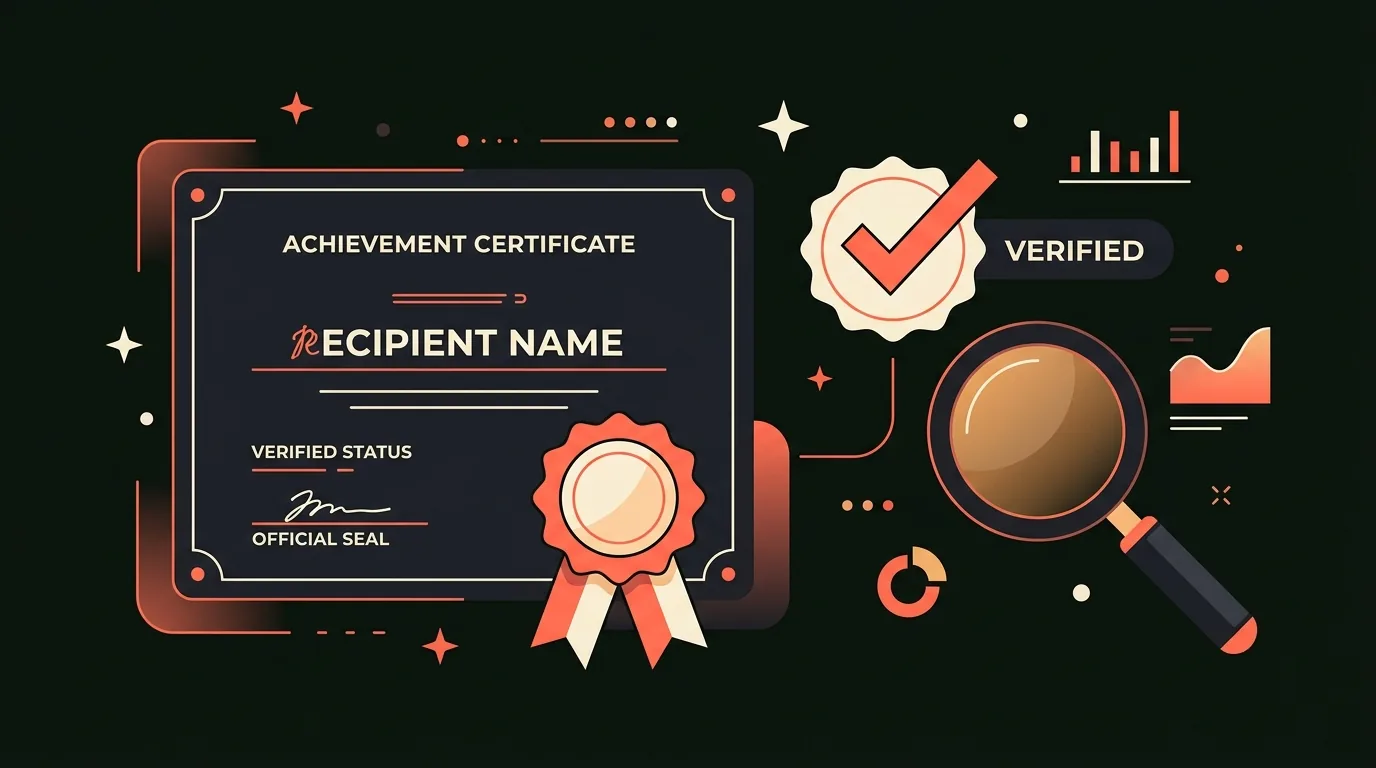
A free typing certificate is a document you generate for yourself at the end of an online typing test: it records your name, your words per minute, your accuracy and the date, and it is free precisely because nobody supervised the test or checked the file afterwards. That makes it a fine practice record and a fine thing to attach to a resume line. It proves nothing about who was at the keyboard, which matters a lot for some requirements and not at all for others. This page sorts out which situation you are in.
The question behind "free typing certificate" is almost never "where do I download one." Free ones are everywhere. The real question is will this count for anything, and the pages selling you a certificate tend to skip it. So here is the honest map: what a free certificate contains, when you want a verified one instead, and when neither is enough, including the case where our own $4.99 certificate is disqualified and something else is required.
What does a free typing certificate actually include?
Across the sites currently ranking for this search, a free certificate is a rendered image or PDF containing some subset of the same six things:
- The name you typed into a box
- Net words per minute (speed after errors are deducted)
- Accuracy as a percentage, and sometimes a raw error count
- The test length (commonly 1, 3 or 5 minutes)
- The date
- The site's name or logo
That's the format. TypingTest.com's certification, for example, runs a 5-minute test and prints name, date, speed, accuracy, typo count and net speed. Others add a badge design or a shareable profile link. None of the free ones I could read describe a way for the person receiving the certificate to check it against a stored record.
Here at TypeTimer, the free artifact is deliberately a bit different, and it's worth being precise about it. Finish any test and you can download a free result card: a 1200×630 PNG with your net WPM, your accuracy, your consistency score, and the test length. No account, no email, no watermark, and retakes are free and unlimited. What it does not carry is your name, an issue date or an ID, because we'd rather it read as what it is, a shareable score, than dress up as a credential. It's the right thing to post, to send to a friend, or to screenshot into a practice log.
Will employers accept a free online certificate?
Sometimes, and it depends almost entirely on how much the score matters to the decision.
Three patterns show up in hiring, and they call for different things:
The number is a filter, not a gate. A posting says "50 WPM preferred," nobody plans to test you, and the line exists to discourage applicants who type with two fingers. Here a free certificate is fine, and honestly a plain resume line ("62 WPM at 98% accuracy, 5-minute test") does the same job. Our guide to typing speed requirements by role covers what those numbers usually mean.
The number is a gate, and someone will look at your evidence. A staffing agency, a transcription client, a virtual-assistant contract. Now the weakness of the free version is exactly the point: it is an image file, and an image file with a number on it can be edited in thirty seconds by anyone with a phone. The recipient has no way to tell an honest 68 from an edited 48, so a careful one discounts all of them equally. This is where a certificate that can be checked earns its keep.
The number is a formal requirement with published rules. Civil service, courts, some county and municipal roles. These usually specify test length, proctoring and validity. Most online certificates, free or paid, fail the specification on its face. Details below, because this is the part everyone leaves out.
One more thing worth saying plainly: no certificate from any website, including ours, proves identity. The test runs in your browser. Treat every online typing certificate as evidence of a score you claim to be able to repeat, not as an exam result.
When do you need a verified certificate instead?
When a human is going to look at the document and needs a reason to believe it.
That's the whole distinction. A verified certificate isn't a fancier image. The upgrade is that the score exists somewhere other than the file you hand over. TypeTimer's verified certificate is a one-time $4.99, and what you get for it is a printable certificate carrying your name, the test length, your net WPM, your accuracy and consistency, the issue date, and a unique verification ID in the format TT-XXXXX-XXXXX. That ID is printed on the certificate along with the address to check it.
The ID isn't decorative. When the certificate is issued, we store the certified name, WPM, accuracy, consistency, test length and issue date against that ID. Anyone holding the certificate can look the ID up and see what we recorded. If the document says 72 WPM and the record says 72 WPM, it's genuine. If it says 72 and the record says 48, the document was altered. That is a narrow claim, and it's the whole product: verification proves the certificate is real and unedited. It does not prove who was typing.
Concrete cases where the $4.99 is worth it: applying through a recruiter or agency that collects documents, pitching transcription or VA clients who have been burned by inflated claims, or any application where you'd rather the reader spend ten seconds confirming than five minutes doubting. Cases where it isn't: you just want to know your speed, you're tracking practice, or you're posting a score. Take the test, take the free card, keep your $4.99.
How does public verification work?
There's no account, no fee, and no software involved on the checking side.
- The certificate holder shares the ID (printed on the certificate, or pasted next to the WPM line on a resume).
- The recipient goes to typetimer.com/verify and enters it.
- The lookup returns what we hold on record for that ID: name, net WPM, accuracy, test length, issue date, and the certificate ID itself.
- They compare that against the document in front of them. Match means genuine. Mismatch means altered. An ID we never issued returns nothing found.
Two small design details that matter in practice. The ID alphabet leaves out the characters people confuse (no 0 versus O, no 1 versus I or L), so an ID survives being read down a phone line or copied off a printout. And verification is free, unlimited, and needs no login, because a check that requires the recruiter to sign up for something is a check that doesn't happen.
If you're on the hiring side and testing several candidates, the recruiter pack covers 10 verified certificates for $29 with one test link to send out.
What situations require a proctored test?
This is the section the rest of the internet's "free typing certificate" pages skip, and it's the one that will actually save you a wasted application.
Some employers publish rules for what counts as an acceptable typing certificate, and those rules routinely disqualify every unsupervised online test. California is the clearest published example. The state's typing certification requirements for CalCareers applicants state that certification must be five minutes long and proctored either virtually or in person, that certificates issued within the last four years are honored, and, in as many words, that the California Department of Human Resources will not accept certifications from tests that were not proctored or were shorter than five minutes.
Read that against any online typing certificate, ours included. We offer a 5-minute test, and our certificate is verified, but it is not proctored, so it does not satisfy that rule, and no amount of verification changes that. Anyone telling you otherwise is selling.
What does satisfy it: a test administered by a state agency or the department you're applying to, or by another approved proctoring organization. Local government publishes its own variations: the City of Rialto's typing certificate requirements call for a certificate from an accredited school or agency showing the agency's emblem, the applicant's name, net words per minute, number of errors, the date, the certifying person's signature, and the agency's address and phone number. Notice that a signature and an issuing agency's contact details are structurally impossible for a self-administered web test to produce.
Where to get a proctored test: the hiring agency itself (many will test you on site), county HR departments, American Job Centers and local workforce boards, community-college adult education programs, and commercial proctored testing services.
And if the role is court reporting or realtime captioning, a typing certificate of any kind is the wrong instrument entirely. Those are separate professional credentials on stenographic equipment. The National Court Reporters Association's certification program tests at speeds like 200 WPM for testimony and realtime reporting, administered through established testing partners. Different skill, different machine, different exam.
Which certificate do you actually need? A decision tree
Start at Q1 and follow the arrows. Each ending tells you what to get and what it costs.
Q1: Who is asking for the score?
- Nobody; it's for me, my practice log, or social → Outcome A
- A private employer, staffing agency, client, or school → go to Q2
- A government agency, court, civil-service posting, or a role with published certificate rules → go to Q3
Q2: Will a person open the document and care whether it's real?
- No, the number is a resume line or a soft "preferred" filter → Outcome A
- Yes, they collect documents, or the score affects whether I'm considered → go to Q2b
Q2b: Do they have a written specification for the certificate (length, proctoring, issuing body)?
- No specification, they just want credible evidence → Outcome B
- Yes, and it says proctored, supervised, in person, or names approved issuers → Outcome C
Q3: Does the posting or the agency's HR page state test length, proctoring, or an approved-issuer list?
- Yes → Outcome C. Assume this before you spend anything.
- It doesn't say, or it says applicants may self-certify → Outcome B, and email HR to confirm before the deadline.
The outcomes
| What to get | Cost | What it proves | |
|---|---|---|---|
| A | Free result card from any 3 minute test: WPM, accuracy, consistency, test length | Free | Your score, as reported by the test you took |
| B | Verified certificate with a lookup ID | $4.99 one-time | The certificate is genuine and unedited, checkable by the recipient at /verify |
| C | A proctored test through the hiring agency, county HR, a workforce center, or an approved testing service | Varies; often free through public workforce services | A supervised result that meets a published specification |
If you land on C, the free and verified options still have a use: as practice and as proof to yourself that you'll clear the bar on test day. Get the number stable before you book the supervised test, not after.
How do you get a certificate in the next five minutes?
- Take a 3 minute typing test. Three minutes is long enough to be credible and short enough to retake. Warm up on one run, then take the score from the second or third. Retakes are free and unlimited.
- Download the free result card. WPM, accuracy, consistency and test length in a 1200×630 PNG. If Outcome A is where you landed, you're done.
- If you landed on Outcome B, upgrade. Choose the verified certificate on the results screen, pay $4.99 through Stripe, confirm the name to print, and download the PNG with your ID on it. It takes about a minute after the test ends.
- Put the ID next to the number. On a resume: "68 WPM at 98% accuracy, 3-minute test (verify TT-XXXXX-XXXXX at typetimer.com/verify)." That sentence does more work than any certificate attachment.
- Certify a score you can repeat. If a serious employer retests you at interview, the honest number makes it a formality and the lucky number makes it a problem. Unsure what to aim for? What counts as a good typing speed has the measured averages, and if the role is transcription-adjacent, use the 5 minute test instead.
FAQ
Are free typing certificates legitimate?
They're legitimate in the sense that a real test produced a real score, and not in the sense of being an accredited qualification. No general typing site is an accrediting body, and some paid services advertise "accredited" certificates without naming the body that accredited them, which is worth noticing before you pay. A free certificate is an honest record of a test you took yourself. Use it as that.
Do employers check typing certificates?
Some do, most don't, and the ones that do usually re-test rather than investigate the document. A supervised 3 to 5 minute test at interview is the common pattern. Where a certificate carries a verification ID, checking is a ten-second lookup instead of an investigation, which is the practical reason a checkable certificate beats an unverifiable image. Either way, applying with a number you can reproduce under observation is the only strategy that survives contact with a real assessment.
What should a typing certificate include?
At minimum: the typist's name, net words per minute, accuracy, test length, and the date. Formal requirements ask for more: the City of Rialto's list includes the number of errors, the certifying person's signature, and the issuing agency's emblem, address and phone number. A self-administered online certificate can supply the first group and, by its nature, not the second. TypeTimer's verified certificate prints name, test length, net WPM, accuracy, consistency, issue date, verification ID, and the address where the ID can be checked.
How long is a typing certificate valid?
There's no universal expiry. Validity is set by whoever is asking. California state departments honor typing certificates issued within the last four years. Some counties use a shorter window. In the absence of a stated rule, treat anything older than about a year as stale: your speed has moved, and a recent test is more persuasive than an old one anyway. Retesting costs nothing here, so re-certify when the score meaningfully changes.
Sources
- California Department of Human Resources / CalCareers, Typing Certification Requirements: 5-minute proctored requirement, 40 WPM minimum, four-year validity
- City of Rialto, CA, Typing Certificate Requirements: required certificate contents and issuing body
- National Court Reporters Association, Certification: speed requirements and proctored administration for reporting and captioning credentials