Typing Games vs Typing Tests: What Makes You Faster
By Mark Fulton ·
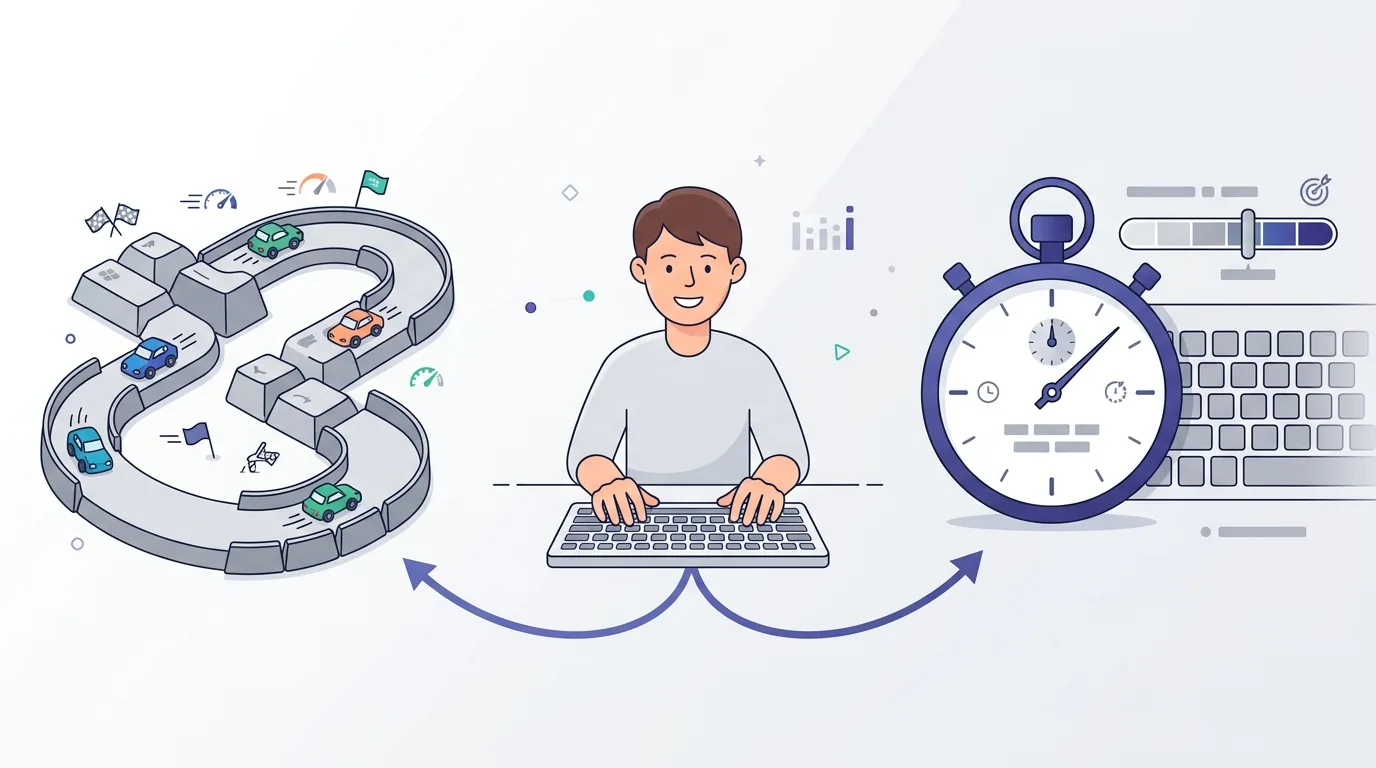
Typing games make you faster by getting you to practice more, and typing tests make you faster by showing you exactly what to fix. Neither one does the other's job well. A game keeps you at the keyboard for twenty minutes because you want to win the next race, and that volume is what builds speed. A plain timed test gives you a clean, repeatable number with your errors left on the table, which is the only way to know whether all that practice is working. The loop that works is games for practice volume and a short test on a fixed schedule for calibration.
We run a typing test site, so you might expect us to tell you tests are all you need. They are not. Games like TypeRacer, Nitro Type and ZType have probably put more hours of practice into more hands than every test site combined, and that matters more than any measurement tool. Here is what each format is good at, where each one misleads you, and a weekly routine that uses both.
What do typing games train that tests don't?
Mostly, they train you to show up. Speed at the keyboard comes from repetition, and repetition is boring. Games solve the boring part.
Volume without willpower. Nobody replays a timed test ten times in a row for fun. People replay races because they lost the last one by a car length. That pull is the biggest advantage games have. Most people who stall at a speed stall because they stopped practicing.
Speed under pressure. A race against real people pushes you to type slightly faster than is comfortable. A solo test lets you settle into a rhythm you already own.
Variety. Shooter games like ZType throw short words at you in unpredictable order. Race games cycle through quotes from books and films. Level based games on hubs like Typing.com adjust to where you are. That variety has a real basis in learning research, which we will get to, though it is weaker than game sites like to claim.
Correct keys before moving on. Many race games, TypeRacer among them, stop you at a mistake until you fix it. That is good discipline: it trains you to notice errors in the moment.
What do tests measure that games hide?
Games give you a score. A good test tells you where it came from.
A repeatable number. Same length, same kind of text, same scoring every time. That is what lets you compare today with last month. A race score depends on which quote you drew, who you raced, and how the game counts words, so two race results are not directly comparable even inside the same game.
Your errors, left in. When a game blocks you at a mistake until you fix it, your error never shows up in the score as an error. It shows up as lost time, blended into your speed. A test that lets you keep typing past mistakes and then counts them shows you the real cost. On our test the results screen separates gross WPM (everything you typed) from net WPM (after uncorrected errors are subtracted), and breaks your characters into correct, incorrect, extra and missed. If your gross and net numbers are far apart, accuracy is your bottleneck, not speed.
That distinction matters because accuracy and speed travel together. In the Aalto University study of typing behaviour across 136 million keystrokes from 168,000 volunteers, faster typists generally made fewer errors, and slower typists especially tended to replace letters with wrong ones.
Pace over time. A test can show where in the minute you slowed down. Ours plots per second pace against your running average and gives a consistency score, so a strong start that fades is visible instead of averaged away.
Sentences instead of word salad. Real typing is sentences, with capitals, commas and full stops. Many games use single words, so a sentence based test is closer to the work you actually do. We covered how much text type and scoring rules move a result in why your WPM differs on every typing test.
Games vs tests, side by side
| Typing games | Typing tests | |
|---|---|---|
| Motivation | High. Competition, levels and scores pull you back | Low. A test is a measurement, not entertainment |
| Practice volume | The main strength. Easy to play for 20 minutes | Poor as a practice tool. Repeating a test gets stale fast |
| Transfer to real typing | Good when the text is sentences, weaker for single words and shooter drills | Good when the test uses sentences with punctuation |
| Measurement quality | Weak. Scores vary with the quote, opponents and game rules | Strong. Same length and scoring every run |
| Error feedback | Often hidden. Blocking errors turns them into lost time | Explicit. Uncorrected errors counted and shown |
| Pressure | Social and competitive, good for pushing pace | Self imposed, good for steady, honest runs |
| Progress tracking | Usually a race average inside that game | A trend across identical tests |
| Best use | Daily practice volume | Weekly calibration and proof of speed |
Does game WPM transfer to document typing?
Partly, and it depends on the game.
The finger movements you build racing a quote are the same ones you use typing an email. If the game uses real sentences, most of that skill carries over. Shooter games that fire isolated short words build reaction speed on common letter patterns, but they rarely train punctuation, capitals, numbers or the rhythm of a long sentence, and those are where document typing slows people down.
The research case for games is real but narrower than you will often read. The strongest argument is something called contextual interference: practicing in a varied, mixed order tends to feel harder at first and hold up better later than practicing one thing in a fixed block. A 2024 systematic review and meta-analysis on contextual interference and transfer in motor learning found a medium overall effect favoring random practice, which supports the idea. The same review found the effect was statistically significant in laboratory studies but small and not statistically significant in applied, real world settings. So variety probably helps, and it is not a guarantee that a game beats structured practice.
There is also direct evidence that typing games do something measurable. In a study of 8 to 10 year olds, children randomly assigned to play online typing games at home for four weeks improved their manual dexterity scores on a standardised assessment compared with a control group. Note what was measured: dexterity, not WPM. It is good evidence that game practice changes how hands move, not proof of a specific speed gain.
The practical check is simple. After a few weeks of games, take a sentence based test at the same length you always use. If your number went up, the game practice is transferring. If your game average climbed and your test did not move, you are getting better at the game.
How should you combine games and tests in a week?
Here is the routine I would use.
- Monday: baseline test. Take a 1-minute typing test three times with the same settings. Write down the best net WPM and its accuracy. Look at the gap between gross and net.
- Tuesday to Friday: games, 15 to 20 minutes a day. Pick games based on what Monday showed you. If accuracy was the problem, choose games that block mistakes and slow down until you stop hitting them. If accuracy was fine, race for pace.
- One day midweek: accuracy check. Run the typing accuracy test, which leads the result with accuracy rather than speed.
- Saturday: calibration test. Same test, same length, same settings as Monday. Compare.
- Every few weeks: a real text test. Paste an email or a paragraph of your own work into the custom typing test. That is the most direct check that practice reaches your real typing.
Two rules make this work. Test far less often than you play, because testing daily turns a measurement into a performance. And never change settings between comparison runs: switching from sentences to word mode, or one minute to three, moves the number for reasons unrelated to progress.
Your results on our test save to a local history on your device with a personal best and a trend line, so the Monday and Saturday comparison is already there when you finish. No account, nothing uploaded.
If you are stuck somewhere around 60 or 70 and want a more structured plan, how to get to 80 WPM goes deeper on breaking a plateau.
Which format fits kids vs job seekers?
Kids. Lean heavily on games. Games solve the hard part with children, which is getting enough repetitions. Keep testing rare, once a month is plenty, and make accuracy part of the conversation so the game habit of speed at any cost does not stick. For age appropriate targets, see average typing speed for kids.
Adults learning or rebuilding speed. A mix, weighted toward games early. A race on a lunch break beats a lesson that never happens. Add tests weekly once you are past the hunt and peck stage.
Job seekers. Lean toward tests, especially in the weeks before an application. Employers test with timed passages, not races, so practice the format you will be judged on. Take the length the employer names and aim for a number you can hit on a bad day. If you need to show a score, a verified typing certificate costs $4.99 and carries a public ID an employer can look up. Be clear on one limit: if a job posting asks for a proctored or in person test, no online certificate qualifies, ours included, so take the test the employer specifies. If you are choosing between test sites, we compared them fairly in Monkeytype alternatives compared.
FAQ
Do typing games actually improve WPM?
Yes, mostly by getting you to practice far more than you otherwise would. Confirm it with a regular test at the same settings, because a rising game score alone can mean you are only getting better at that game.
Why is my TypeRacer speed higher than my test speed?
Race quotes are short, you will meet some of them more than once, and racing against people pushes your pace. Many tests run longer, use unfamiliar text and subtract uncorrected errors from your net score. Both results are real. The test number is the one to track over time because its conditions do not change.
Are typing games good for adults?
Yes. A game keeps you practicing when a drill would not, at any age. Options range from race games like TypeRacer to shooters like ZType and Typing of the Dead. Pick one that uses full sentences some of the time, and pair it with a weekly test.
How often should I test instead of play?
Play most days and test about once a week, using the same test and the same settings each time. Test more often only in the run up to a job test, when practicing the exact format matters.
Play your games this week, then come back and calibrate. Take the 1-minute typing test at the same settings each time, and your trend saves on your device so you can see whether the practice is paying off.